Predictive Audiences and Contextual Targeting: Understanding What Drives Performance Today

Sofia Meadway
Product Marketing ManagerAdvertisers have more data than ever, yet converting these signals into precise, scalable targeting has become increasingly difficult in the modern media ecosystem.
Whether it be nuanced privacy regulations, increased signal loss, or the expansion of fragmented media consumption, marketers face new and evolving challenges in reaching their optimal audience at the right moment of intent.
This collective challenge has resulted in renewed interest in two privacy-forward approaches: contextual targeting and Predictive Audiences. Contextual targeting aligns ads with relevant content, while Predictive Audiences leverage data-driven models to identify consumers that are most likely to share specific interests or behaviors.
While each relies on a different set of signals and methodologies, the strongest activation strategies approach these as complementary solutions to their targeting challenges. By understanding how contextual targeting and Predictive Audiences differ, and where they enhance the effectiveness of each other, allows advertisers the ability to balance precision with scale, expand addressability, and improve campaign performance.
With this in mind, we’ll examine what distinguishes each methodology, how advertisers can turn today’s immense volume of data into scalable action, and how Comscore and Proximic bring these approaches together to create more seamless, effective campaigns.
A Quick Refresher: What is Contextual Targeting?
Contextual targeting aligns ads to the content someone is consuming, placing a message in a relevant environment; for example, someone reading a travel blog might see an ad for a hotel because the content itself suggests they may be considering taking a vacation.
Historically, contextual targeting has relied heavily on keywords and broad categories to define their audiences, often leading to inaccurate interpretations due to their generalities. In this context, a keyword like “credit card,” that has multiple classifications could signal high intent value such as a user researching the best travel credit cards, BUT it also could appear in an article about credit card fraud, debt, or financial hardship that would miss the potential target.
As tech has advanced, so has the methodology and accuracy of contextual solutions. The once rudimentary have become far more sophisticated through the application of AI‑driven, semantic analysis that provides a more nuanced understanding of meaning, tone, and sentiment. What this means for modern contextual targeting is more effective results in regards to relevance, brand suitability, and scale in environments like CTV where traditional identifiers are not always available.
Without this deeper understanding and inference into the context of a given situation, advertisers risk their ads appearing in environments that do not align with their brand or campaign goals, thus increasing wasted spend.
Where Predictive Audiences Fit in the Equation
While contextual targeting focuses on the content consumers engage with, Predictive Audiences go a step further by leveraging patterns and behaviors to anticipate who is most likely to act.
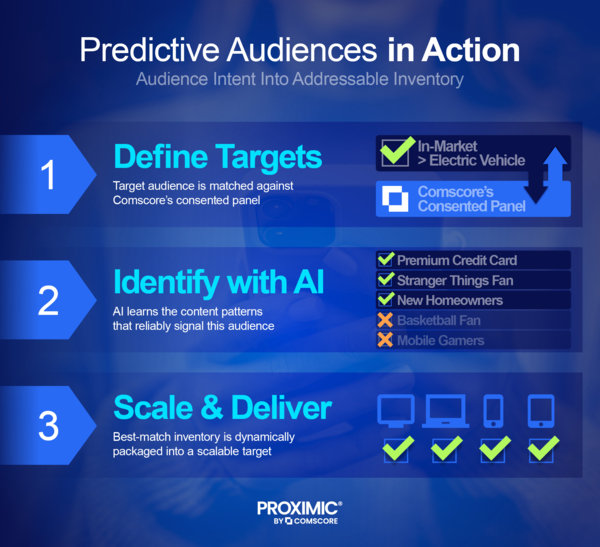
Predictive Audiences use large-scale, consented behavioral insights and ID-free methods to understand how consumers engage with content across the media ecosystem. These insights then provide the fuel for AI models that analyze these patterns to understand and predict which environments audiences are most likely to engage with next.
In real world terms, instead of targeting people solely reading travel content, a Predictive Audience model might identify that frequent travelers also have a high propensity to engage with content related to luxury credit cards, airport lounges, or even specific entertainment genres. AI is then used to flag the relevant inventory that matches the high-propensity content topics, expanding reach to audiences who may not actively be in a travel moment, but exhibit strong series of signals that imply future intent.
Predictive Audiences complement contextual and ID-based strategies by translating real audience behavior into content-based activation. Rather than replacing existing targeting methods, they add an incremental layer of intelligence that connects demonstrated consumer interests and intent with the environments those audiences are most likely to engage with next.
This helps advertisers expand beyond obvious placements, uncover new high-value opportunities, and improve performance across channels such as CTV, audio, and iOS, all without relying on cookies or traditional identifiers and resulting in a privacy-forward strategy that extends addressable reach while remaining grounded in meaningful behavioral insights.
The Key Difference: Contextual vs. Predictive
A helpful way to think about the difference between contextual targeting and Predictive Audiences is through a few simple analogies:
- Contextual targeting is like placing a billboard on a highway. You understand the environment and assume relevance in that moment. It’s effective, but you don’t know who’s driving or where they’re headed.
- Predictive Audiences are more like GPS navigation. Learning from patterns and past journeys to anticipate where audiences are likely headed next and continuously adapting based on observed outcomes.
Why This Matters for Advertisers
The greatest impact comes from using these approaches together to expand addressability without sacrificing relevance. Contextual targeting aligns creative with the content, seasons, and cultural moments shaping consumer attention, while Predictive Audiences extend reach beyond the most obvious environments to uncover high-value opportunities advertisers might otherwise overlook.
By combining contextual signals, the power of Predictive Audiences, and traditional ID-based audiences, advertisers can unlock a complementary targeting framework that balances relevance, reach, and precision.
Looking Ahead: Where Proximic Fits
Now that we understand what these methodologies are and how they work, the next question is practical: How can advertisers apply them to real campaigns?
Proximic brings contextual intelligence and audience understanding together, acting as the activation layer between Comscore’s trusted, large-scale audience insights and real‑world media delivery. Built on Comscore’s currency-grade data, which captures how people consume content across screens, Proximic uses AI and predictive, ID-free technology to translate behavioral insight into action.
The result is a more effective way to identify high value environments most likely to reach consumers, extend reach and scale campaign performance, without relying on cookies or other identifiers. In one campaign analysis, Predictive Audiences increased incremental reach by +146% against client KPI’s.*
Just as importantly, Proximic integrates directly with major DSPs and SSPs, allowing advertisers to activate within existing workflows.
The bottom line is simple: contextual targeting explains what content someone is engaging with; Predictive Audiences use real consumer behavior and AI to predict where those audiences are likely to show up next. In a market shaped by signal loss and rising privacy expectations, Proximic reflects Comscore’s point of view on what comes next: more connected, smarter targeting that links people, content, and outcomes.
Source: *Comscore campaign measurement data from individual case study
Proximic by helps buyers and sellers turn audience insight into meaningful outcomes across a changing media landscape. Contact us learn how our contextual and Predictive Audience solutions can support more connected, effective targeting strategies.